
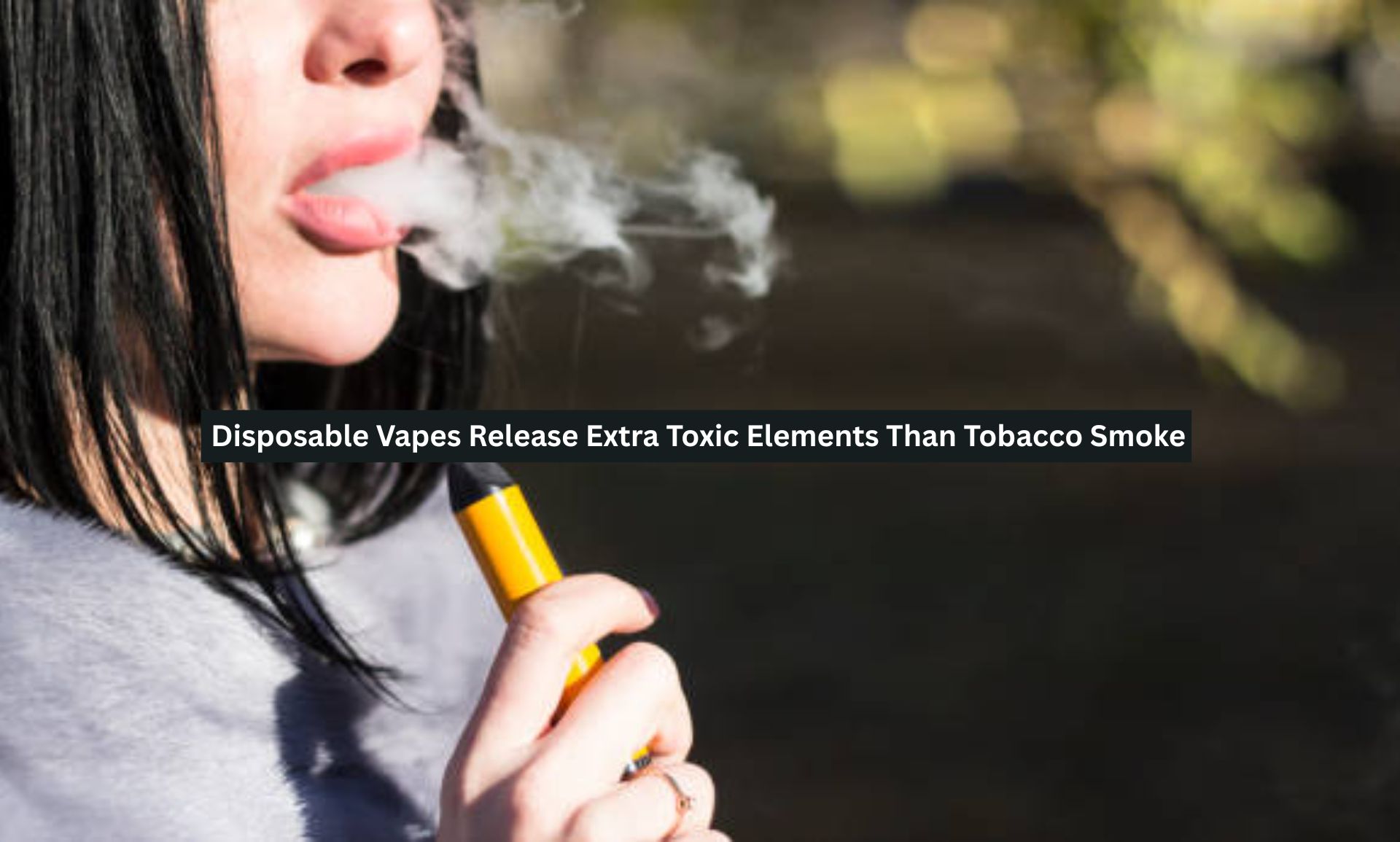
Regardless of being unlawful in the US, disposable e-cigarettes are nevertheless without difficulty to be had in shops national. Scientists are calling for the federal government to ramp up its enforcement of the ban after the discharge of a new examine displaying that single-use vapes launch better concentrations of poisonous metals than reusable e-cigarettes and traditional cigarettes do (ACS Cent Sci. 2025, DOI: 10.1021/acscentsci.5c00641).
Findings From the Study
The researchers observed that one of the disposable vapes they studied released extra lead at some point of a day’s worth of use than almost 20 packs of tobacco cigarettes. “After I analyzed the metals in the aerosols, I quantified lead at such intense concentrations that I notion my instrument was broken,” says Mark R. Salazar, one of the examine’s authors and a PhD candidate in Brett A. Poulin’s environmental toxicology lab at the College of California, Davis.
Toxic Metal Concentrations
Salazar and his colleagues used a specifically designed vacuum to draw the vapor out of disposable vapes, then captured the aerosol on filters and analyzed the chemical contents. They accomplished this system till the devices stopped working.
Lead used to be observed in aerosols at concentrations as excessive as 51.9 elements in step with million (ppm); the group additionally located excessive concentrations of nickel (19 ppm), copper (24 ppm), zinc (87 ppm), chromium (4.9 ppm), and antimony (2.3 ppm). This degree of exposure is “deeply concerning, mainly for the reason that the goal marketplace for those products is commonly young human beings and teenagers,” says Jonathan H. Shannahan, a toxicologist at Purdue College who was once now not worried within the examine.
Oxidation States and Toxicity
The have a look at authors also checked out the oxidation kingdom of some of the elements because that in part dictates their toxicity. The ones data had been relevant for antimony, which used to be gift within the aerosols in its poisonous +3 oxidation country and was greater plentiful in flavored vapes than simple ones. Although the scientists detected chromium, the detail used to be not in its distinctly toxic +6 structure.
Cannabis Rolling Papers May Be Loaded With Dangerous Metals
The longer the devices were used, the more the attention of the elements inside the aerosols became. For instance, chromium and nickel accelerated by almost 1,000-fold over a disposable e-cigarette’s life. The researchers took the devices apart to analyze which in their unused components contained heavy metals. They located that a number of the toxic chemicals had been present within the e-liquid before the vape has been used. Metals may additionally have leached into the e-liquid from other elements of the device, including the heating coil or the electronics, to in the long run turn out to be inside the aerosol.
Antimony and Other Metals in Aerosols
The examine authors additionally checked out the oxidation state of a number of the factors because that during component dictates their toxicity. Those facts were relevant for antimony, which was present inside the aerosols in its toxic +3 oxidation nation and was once greater abundant in flavored vapes than plain ones. Even though the scientists detected chromium, the element was once no longer in its tremendously poisonous +6 shape.
Metals Leaching and Device Breakdown
The longer the devices had been used, the more the attention of the factors within the aerosols became. As an instance, chromium and nickel improved via almost 1,000-fold over a disposable e-cigarette’s existence.
The researchers took the devices aside to investigate which in their unused components contained heavy metals. They determined that some of the poisonous chemical compounds were present inside the e-liquid earlier than the vape has been used. Metals may have leached into the e-liquid from other parts of the tool, including the heating coil or the electronics, to ultimately emerge as within the aerosol.
Flavorings and Chemical Interactions
Najat Saliba, an atmospheric chemist at the American College of Beirut who was once no longer involved with the study, says the contents of the e-liquid may also be performing as a catalyst to the leaching system. “Positive flavoring retailers may also beautify the dissolution of metals from heating coils into e-drinks, in all likelihood on account of chemical interactions with steel surfaces,” she says.
Call to Action From Researchers
For Salazar and Poulin, the take-home message of their take a look at is obvious: Government and regulatory businesses need to act. “These gadgets are already no longer authorized on the market,” Poulin says. “That is a name for enforcement.”
What Are Glow Sticks, and What’s the Chemical Response That Makes Them Light Up?
Breaking some thing hardly ever sparks joy—until you’re activating a glow stick. Simply bend the plastic baton till you hear a snap, and behold, you have a radiant wand to illuminate your way. Whether you’re trick-or-treating on Halloween or dancing the night time away, glow sticks offer a groovy supply of light. That light is made through a chemical response—a phenomenon known as chemiluminescence.
The Reaction Behind the Glow
In glow sticks, the chemical substances that react collectively to create the light are stored separate until the right second. The glow stick’s outer plastic tube holds an answer of an oxalate ester and an electron-rich dye in conjunction with a pitcher vial full of a hydrogen peroxide answer. The signature snap that starts the response signals which you’ve damaged the glass tube, liberating the hydrogen peroxide. When the chemical substances mix, the reaction goes through numerous steps before liberating light.
First, the hydrogen peroxide and oxalate ester react to structure a high-electricity intermediate, however the proper nature of that intermediate continues to be something of a mystery, says Gary B. Schuster, a chemistry professor on the Georgia Institute of Technology who has studied the reaction. Many chemists agree with it’s the strained molecule 1,2-dioxetanedione. However, notwithstanding 50 years of searching for it, there may be no direct proof of that compound.
Despite the fact that chemists aren’t sure of the ideal shape of the high-strength intermediate, they understand it’s a great electron acceptor. It snags an electron from the dye after which breaks down into carbon dioxide and a negatively charged carbon dioxide radical anion. The dye, which has come to be a undoubtedly charged radical cation, then takes returned an electron from the CO₂ radical anion.
In taking lower back the electron, the dye gains excess electricity. The molecule uses that energy to transport into an excited nation earlier than dropping backtrack and emitting the power as a photon of light. Your glow stick glows.
Discovery of Glow Stick Chemistry
Although several innovations introduced glow sticks to the loads, the underlying chemistry used to be found in a janitor’s closet in New Jersey in 1962. Back then, Edwin A. Chandross, a newly minted chemistry PhD working at Bell Laboratories, was tinkering with mild-producing chemical reactions. “The organization had very generously furnished me with a dark room to do chemiluminescence experiments,” Chandross quips, alluding to the small, darkish closet subsequent to his lab.
In the future Chandross uncovered a xanthone by-product he’d prepared with oxalyl chloride to hydrogen peroxide with a touch delivered anthracene dye inside the blend. The response produced susceptible light. But when Chandross tried to copy the response with a cleanser sample of the xanthone by-product, the aggregate stayed darkish. That’s when it happened to Chandross that it were leftover oxalyl chloride reacting with the hydrogen peroxide and dye within the first experiment. When he attempted mixing those 3 additives, the mild lower back.
“The patent legal professional assigned to my department declined to report a patent,” Chandross says. “And I didn’t realize how big this clearly was.” Chandross published the response in the journal Tetrahedron Letters (1963, DOI: 10.1016/S0040-4039(01)90712-9), and it stuck the attention of Michael M. Rauhut, who was once supervisor of exploratory studies on the chemical association American Cyanamid.
